Turkey
Oh love, what hours were thine and mine
In lands of palm and southern pine;
In lands of palm, of orange-blossom,
Of olive, aloe, and maize and vine.
Tennyson, The Daisy
Together let's
eat
ears of wheat,
share a grass pillow.
Basho, On Love and Barley
|
14th March to 26th April 2005 It
has been found again!
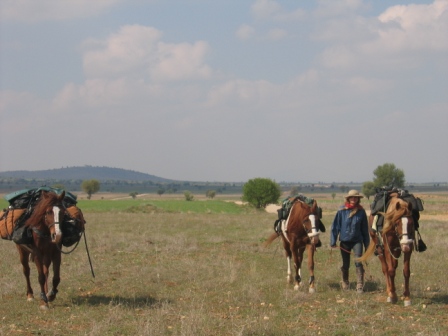
“Hello. Whatisthis? Goodbye. Whatisyourname? Whereareyoufrom? Hello. Hello.” Shuffle and repeat. And repeat and repeat and repeat. Answering these questions makes no difference; the Turkish children just love the sound of these English words so they keep on saying them, over and over. It was our first night in Turkey and the village muhtar (mayor) had shown us to a scruffy patch of ground behind the mosque. The horses weren’t too impressed with this new country; they had to be tethered to trees and there was no hay to be had, only saman (straw). There wasn’t much peace either. We were visited at least ten times that evening by more or less the same group of kids. Every so often they’d all walk off with a loud chorus of goodbyes, only to return ten minutes later for another fun round of what-is-your-names.
This was just a taste of things to come but at least we were amongst friendly folk: endless questions, beeping horns, waving hands, cafés full of men demanding we stop for a çay (black tea – pronounced chai). If you want to find out how to say ‘very beautiful’ in lots of languages, just keep riding from country to country on a good looking Arab horse – the words “çok güzel!” rang in our ears all day. After a final day or
two on the plains of Thrace, we were soon back in hills, winding up
through pine forests and keeping our eyes peeled for eagles. On
reaching the crest of a ridge, we were rewarded with a fine view:
the Aegean, sparkling in the sun. It was our first sight of sea
since we’d cantered across a Brittany beach nine months before. That
had been a wild day, our faces blasted by a mixture of Atlantic
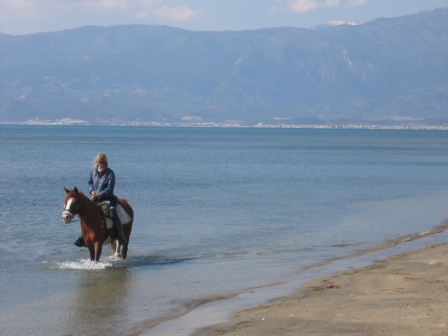
spray and Atlantic rain. The Aegean was much more civilised; by late
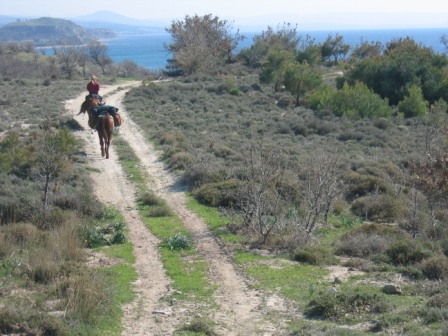
afternoon, after a long descent on a hard To avoid all the bigcityness of Istanbul we’d decided to head down the Gallipoli Peninsula instead. This forced us back west for a couple of days but it was great riding; the horses were fresh and strong after their long forced rest in Greece and there were good dirt tracks from village to village. We stayed high along the spine of the peninsula and now we were spoilt for sea views; our new friend the Aegean down below us to our right, the Sea of Marmara tempting us on our left. The map had come to life, the geography had jumped out to meet us. There was plenty of history here too. We were riding through a weird moonscape of bare hills and steep gullies that had seen some horrific battles during the first world war. It wasn’t hard to imagine how grim it must have been trying to fight in this terrain. One hundred and thirty thousand men lost their lives here; Turkish and allied soldiers, many of whom were from Australia and New Zealand (the ANZACS), following orders of British generals as part of an ill-conceived plan to take Istanbul. Today, the cordial relationships between the countries involved and the dignified memorials make such a tragedy seem all the more senseless.
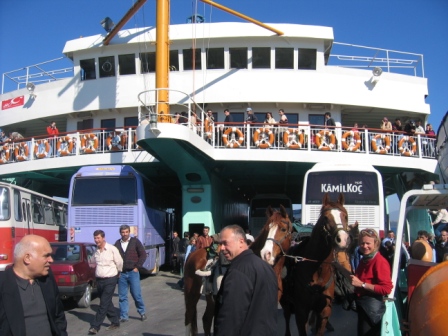
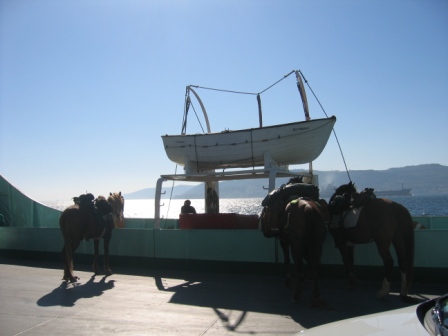
These land battles had followed the defeat of the British Navy by the Turks in the Narrows of the Dardanelles (Hellespont) on 18th March 1915. Ninety years and a day later we’d reached the end of one continent and this short stretch of water was all that separated us from the next. With fortunate timing, we rode through the town of Eceabat and straight onto a ferry. The boat was packed and Audin, Hannah and Sealeah were centre of attention, standing on the open deck behind all the lorries and buses. Seasoned sailors by now after their crossings of the English Channel and twice over the Danube, they dozed in the sun as Europe faded behind and Asia grew bigger up ahead.
Due to the 90th anniversary celebrations, Çanakkale was packed and we had to fight our way through the crowds on the quayside, trying to find a spot big enough for the five of us. A TV crew suddenly appeared from the throng and I left Lisa to answer the questions while I escaped to try and buy a map. There was a celebratory atmosphere and we rode off down the busy high street to claps and cheers, watching backwards-running cameramen bumping into cars and lampposts as they tried to film us. It was a big town, the ferry had dropped us right in the middle and now it was getting late. After a long slog up a big road we finally found enough grass for a night, just as the sun disappeared behind a Gallipoli hill. Mug of tea in hand, we looked down at the lights of the ships gliding through the Dardanelles and switched on our tiny radio: “…and now we go to rugby union. Wales have beaten Ireland at the Millennium Stadium in Cardiff, winning the Six Nations Grand Slam for the first time in twenty seven years…” YES! They heard our shouts in Cardiff. Some days are just great. A quick canter along the coast the next day brought us to the ancient city of Troy where, around 1250BC, the Greeks needed ten years of fighting and a crafty wooden horse trick to gain entry. All we had to do was pay ten million lira. The horses had to wait outside but they didn’t mind too much; they had a safe field, the grass was tasty and – unlike me - none of them had just read the Iliad so they wouldn’t know what all the fuss was about anyway. We were soon re-united with our chestnut chargers, crossers of continents, and we were there: ‘far on the ringing plains of windy Troy.’
By this point I’d started spouting like Homer and, immensely annoying though it was for Lisa, I couldn’t stop. In the lead was hot-blooded Hannah, cargo-carrier, bearer of baggage, tangler of tether ropes. Not far behind came the Dancing Queen himself, able-bodied Audin, extender of the tongue of friendship. Hot on their heels came swift-footed Sealeah, turner of heads, grazer of grasses, mane flowing like a river of gold. The little procession crossed the plain and climbed easily into the hills. The sun went down and all the ways grew dark. At the Welsh encampment that night, the hunger of accursed bellies was soon satisfied and the gift of sleep came quickly to all. When early-born, rosy-fingered Dawn appeared, lovely-haired Lisa, healer of horses, spoke and her words were winged, they did not leave her lips for nothing: “Husband? How long are you going to carry on with this claptrap?”
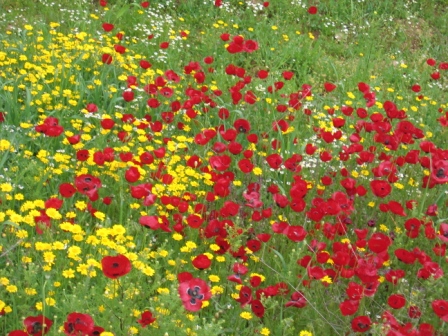
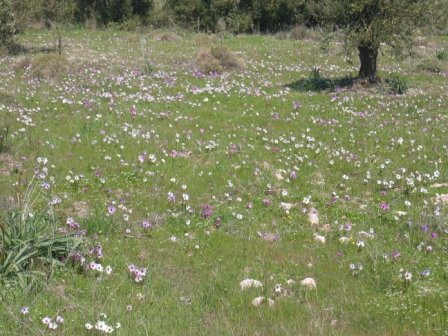
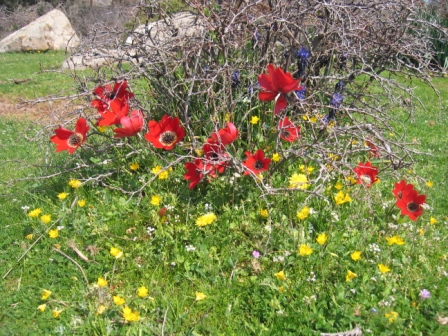
Between Troy and another ancient city, Assos, we followed tracks that took us along miles of olive groves, along cliff tops and down onto deserted beaches, some of which went for miles although the sand and shingle was a little soft in places. Spring was exploding all around us: the welcome sight of green green grass and huge carpets of anemones – purple, white, pink, red. The new grass allowed a return to our long picnic / grazing stops and the strong sun brought back attacks of the familiar post-lunch flopsidaisicalness. It is not spring until you can plant your feet on twelve daisies
One of the joys Basho, On Love and Barley We spent one memorable lunchtime at the ruined harbour of Alexandra Troas. Ancient columns and huge stone slabs stuck up from the grass or lay scattered, half-submerged in the water. Spring flowers brought bright dashes of colour and tortoises scurried everywhere, trying to make up for lost time after a long hibernation. It felt like a kind of emergence for us too - the hard winter in the Balkans was finally behind us. Best of all we had this magical place all to ourselves. Only later, looking it up in a well known tourist guidebook, did I find out why; ‘probably not worth a special visit’ it said. Thank you to whoever wrote that.
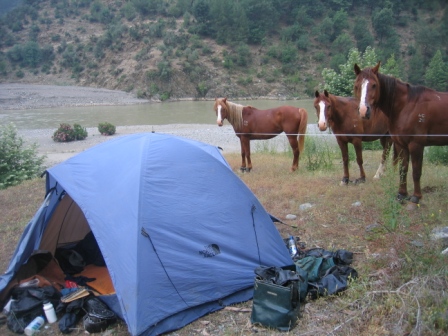
Just before reaching Assos, our spring joy was suddenly shattered. Lisa writes: That afternoon Sealeah developed a rapidly worsening lameness. There was no obvious lesion on her leg or in her hoof, but on arriving at our olive-grove bivi spot I pared out the foot and found a small tract starting at the edge of the frog (spongy bit in the middle of the hoof) and penetrating deep into her foot. Some pus came out and I pared out as deeply as possible but my blood was running cold and I felt sick with fear – I knew if this was just a shallow pocket of pus where some glass or sharp stone had cut into her foot she’d be fine, but the tract was heading towards the navicular bursa (capsule of joint fluid) and tendon sheath; if these had been penetrated the consequences, if not treated surgically, would be dire for Sealeah. In our olive grove hideout I didn’t even have the equipment to establish whether these structures had indeed been breached. Immediate transit to a sufficiently equipped equine clinic was not an option here so I did what I could with the vet kit we had (this is vast but in the circumstances seemed pitiful!). Needless to say I didn’t sleep a wink but spent the night wracked with worry and cursing myself for putting our precious mare in this position. Thankfully she steadily improved during the next day and it became more and more obvious that vital structures had not been penetrated – relief! That night was one of only two occasions (the other being the traffic-congested hell in parts of north-east Italy) when I doubted whether we should have risked our horses on such a journey. Having said that, as anyone who knows horses is aware, everything we do with them – jumping, breeding, racing, hacking – carries a risk ( I have even seen horses break legs when turned out alone in flat well-fenced paddocks) and at least on this trip we’re with them twenty four hours a day and their welfare is our constant priority. The other side of the coin is that there is absolutely no doubt in our minds that they are enjoying this journey. Moving along in a small group between grazing areas is a fairly natural life for a horse. They are curious and social animals who enjoy novelty and varying terrain. Sealeah’s favourites are narrow winding tracks through woods, scrambling up steep mountain tracks and, best of all, chasing after nosey calves and sending them back to their own herd where they belong. All three, even after all this time, dance like looneys when we hit a wide riverside track or open grassland where they know a good gallop is on the cards. They’re also very affectionate towards us, alert and concerned if any one of us five is separated. They greet us with a whinny on our return – all the more enthusiastic if we have a plastic carrier bag of shopping in hand. They stand over us if we lose the battle with our eyelids after lunch and at night they gather round the tent and we have to crawl past twelve legs to get the day started. The intensified relationship with the horse is a major pleasure of travelling like this, as anyone who has done so could testify.
Assos turned out to be the perfect place for a brief rendezvous with Lisa’s parentals, who’d just brought a large quantity of drugs into the country. To make matters worse, they claimed to be carrying it for “somebody else”. Really! - at their age you’d think they’d know better. Hadn’t they seen Midnight Express? As responsible son-in-law there’s only so much you can do: warn them about the dangers, try to make them realise it’s just not worth it, even if it is what all their friends are doing. But to be fair, they didn’t have any choice, daughter Lisa had spoken: the vet kit had to be replenished.
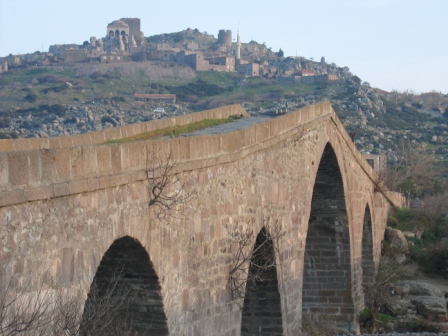
We’re very grateful to Diana at the homely Old Bridge House Pansyon who put us all up / put up with us all while we sorted equipment, swapped winter for summer gear and shod the horses (who’d taken over and eaten half of the front garden). The in-laws weren’t the only distinguished visitors to Assos: Aristotle lived here for a few years, philosophising down at the gymnasium, and St Paul popped in for a bit of pagan-converting on one of his jaunts around the Med. After Assos, we
continued around the Gulf of Edremit, trudging through a concrete
madness of hotels, restaurants and holiday apartments – the
coastline had been
Moving up and down
mountains requires energy and finding enough horse food was
sometimes a challenge to say the least. Yes, the spring grass was
growing but when it came to eating it there was some serious
competition around: cowherds, shepherds and This approach also gave us some precious evening peace, some respite from the daytime barrage of questions and staring and more questions and ‘come here!’ whistles and vigorous flagging-down demands for us to stop and drink chai. The constant attention could be wearing but the Turks’ only ‘fault’ is being too nice, too friendly, too interested. They didn’t know we’d had the full round of questions several times already that day, or that if we stopped at every call for chai we’d need three years to get across the country.
Sitting around in
cafés all day fiddling with worry beads while the women are doing
the work is a serious matter for Turkish men; a chai-rejection has
to be handled quite carefully to avoid giving offence. One evening,
at what we thought was a well-concealed bivi spot - a high patch of
grazing some two hours ride from a village – a man appeared through
the bushes. He’d driven round in his lorry and now he’d found us. He
demanded to know why we hadn’t stopped for a glass of chai with him
at his café in the village. We tried to explain but clearly not very
successfully. “Nescafe, you could have had Nescafe,” he said, before
moving on to the question of why on earth we were camping up here in
this terrible place instead of staying in the village. “You’ll be
cold at night” was his first attempt. We pointed out our sleeping
bags. “There are foxes…and dogs ” he tried next. We pointed out
Hannah, our Head of Security and one of the best in the business. He
grabbed our dictionary. “Military zone, this is a military zone.” We
pointed out the distinct lack of soldiers, signs or anything
remotely military-ish. He was getting desperate, his searching
fingers flicked frantically through the pages. Then, suddenly, he
found it, the word he was looking for, here was his trump card:
In some of the remoter mountain areas (cretinism a speciality) our arrival was just a bit too exciting to cope with and a great furore had to be made. Passports had to be produced for the muhtar, our names and numbers taken down in a pointless book and the whole matter discussed over the telephone with the Jandarma (military police) before we could be allowed to carry on. On a few occasions, concerned villagers must have reported the presence of a strange tent in the vicinity because the Jandarma have turned up to investigate, with grave-looking villager in tow. Why they have to come at one o’clock in the morning is anybody’s guess – maybe sleep deprivation is part of the interrogation technique they learn at training school. The first time this happened there were six men with machine guns so I pretended to be asleep and left Lisa to do all the talking. The next time, it was my turn and things were going pretty well until I was asked whether we had any children. At this point Lisa wondered quite audibly and very colourfully whether this information was strictly necessary for his little notebook, especially at one o’clock in the b*&%*+d morning. These incidents were, however, mere islands in a sea of warmth, friendliness and hospitality. Of course, many of the chai invitations were accepted, usually where we could also get on with something else like watering the horses or buying food at a village shop. By ‘we’ here, I actually mean Lisa, because I was the one who had to do all the difficult tea drinking – it’s a man’s job in Turkey, a cultural thing that you can’t argue with. After shaking hands with the whole café, it would be Horse Travelers’ Question Time. Where are you from? Where are you going? Why three horses? Where do you sleep? Isn’t it cold at night? Aren’t the horses cold at night? What do the horses eat? Are you a tourist? What is your name? How much money were the horses? Is Turkey beautiful? What is your job? Etc etc.
This first question is the hardest. Ever since we left Italy, the only people who’ve heard of Wales are those with an interest in football (OK, apart from one man in Romania who’d seen Wales on the Discovery Channel). One man’s eyes lit up when I said we were from Wales. “Yanroosh! Yanroosh!” he exclaimed, followed by a very realistic flying header impression. “Ah, yes, Ian Rush, one of the best” I said. (The next thing I knew, he was leading me to his field, swinging his sickle and handing me a big bunch of Lucerne for the horses.) The Turkish word for Wales is ‘Galler’, i.e. Gauls, the Roman name for the Celts and meaning ‘barbarians’. So we’re basically telling everyone in Turkey that we’re barbarians, no wonder they look worried. Usually, ‘Galler’ just leads to blank looks or, even worse “Allmanya? (Germany)” so we try ‘Brittanya’ and they say “Italya?” In the end we’re forced to give up and say “Ingilterre yakın (near England)” with lots of stress on the ‘yakın’ and as little as possible on the ‘Ingilterre’. But as soon as you’ve said the Ingilterre you’ve blown it, it’s already too late and the buzz goes off through the crowd, Ingilterre, Ingilterre, Ingilterre…
Sometimes, on trying
days, we just give up early in this process. There are whole
villages and entire towns that think we’re German, French, Italian.
But first prize in the wildly-off-the-mark competition must go to a
man met on the road to Bergama:
Finding places to
stop for more than one night isn’t always easy but we managed it at
Bergama, Sardes and Pamukkale. These are all well known tourist
sites and they provided a bit of added historical interest on top of
the usual rest day chores. Sardes was capital of the Lydians, one of
the many kingdoms established by migrating Greeks sometime after the
fall of the Hittites. Phrygians, Ionians, Lydians, Lycians,
Pamphylians, Hittites, Araldites, Loctites...you can very easily get
stuck trying to remember all these names. The first ever coins were
minted by the Lydians at Sardis and, judging by the size and number
of the conical burial mounds at Bin Tepe (A Thousand Hills), it’s
more than likely they spent most of them on funeral arrangements.
(Somewhere back in the distant past when the mountains were French I taught Sealeah to lift her right foreleg when I said “right” and her left when I said “left” - teaching her the difference between right and wrong is proving a lot trickier. A bit later on in Italy I blew her a kiss over a fence, she leaned over to give me a big smacker on the lips and I made the mistake of rewarding her with a bite of my apple. She never forgot. By then she was shaking hands in English, French and Italian - I’d realised she wasn’t taking a blind bit of notice what I said, just watching my arms when I pointed to each leg. So now Slovenians, Hungarians, Romanians, Bulgarians, Greeks and Turks have also seen that this clever horse can speak their language.) The Saturday kids at Sardes thought this little routine was just grand: sar (right), sol (left) and big kiss. Sar sol kiss, sar sol kiss, sar sol kiss...We tried to stop them but we were heavily outnumbered. We also discovered that neither of us were very gifted in the child-management or crowd-control departments. So poor old Sealy Belle spent the whole day goose-stepping around the field and kissing kids on the nose. She got a bit carried away at times; her hooves were really flicking out towards those little kneecaps – its a wonder that there weren’t more injuries. But it wasn’t all bad, this Sardes stop. Although mentally drained we were physically filled, and then some – the food donations had reached record levels: bottles of milk, tubs of yogurt, jars of honey, gözleme (rolled cheese and spinach pancakes); round breads, flat breads, feta cheese, eggs and a five kilo bag of sultanas. Those sultanas kept us going for days...
After a long hard session winding through and over the tortuous Aydin Mountains, we found a great place to rest for a few days at the thermal springs resort of Pamukkale / Hierapolis, a tourist hotspot if ever there was one. Wandering around surrounded by coach loads of holiday-makers and their acres of exposed pink-white flesh was a bizarre, out-of-our-trip kind of experience; we’d been suddenly beamed, Star Trek-style into everybody else’s holiday. We had an unpleasant out-of-pocket kind of experience too; one small lunch at a café cost us more than we’d spent in the last fortnight. One moment you’re a guest and the horses are ‘çok güzel’ and you can’t eat all they give you; then just down the hill you’re probably German and bulging with Euro cash - güten tag, güten abend, wollen sie essen?. Still, it was well worth stopping at a thermal spa. Never mind all the healing properties of these hot waters, I can personally vouch for their ability to remove twenty four days worth of accumulated dirt, sweat and grime. The horses weren’t allowed in the pools but after four days rest and a diet of freshly-cut lucerne they were as refreshed as we were and ready for another eastwards push, up into the heartland, Central Anatolia.
30th April to 25th May
Now as I was young and easy under the apple boughs A strange thing
happened after we left Pamukkale. As often before we climbed up from
the valley into the hills – a long hard pull on a hot day – but
these hills didn’t go back down the other side again, not very much
anyway, not as much as proper hills are
Our route through
this rugged region lead eastwards: firstly over to Dinar, then
weaving through the Turkish Lake District, passing north of Konya
across the great plateau to volcano country and finally into the
fairytale world of Cappadocia. There was a feeling about this place
that reminded us of parts of the Andes or the Himalayas: clear air,
sharp light, strong sun and cold nights. (Just like Christmas Day,
Turkey can go from roasting to hot and hot to cold in a very short
space of time.) As further proof There were still
valleys and villages around of course, it was just that they were
high up. The Turks don’t hang about when there are bits of land
around that can physically be ploughed; from dawn to dusk red Massey
Fergusons chugged up and down everywhere. The amount of good pasture
land was tiny in comparison with that used for crops. Most villages
have a grazing common but beyond that its crops all the way until
mountainsides get too steep and rocky – and by then you’re into goat
territory. Many times we’d follow field tracks for miles that would
come to an abrupt end in a sea of wheat and barley. We’d curse and
swear and wonder how much food one
Hannah didn’t share our views on arable farming. To her, free from the constraining influence of a rider, it was like charging down a never-ending confectionary aisle in a giant hypermarket. Just help yourself, eat as you go and never get to the checkout. We’d pull her off the edge of the wheat on the left and she’d use her momentum to drag us with her into the barley on the right. If I was ahead on Sealeah I didn’t have to look round to know what was going on, Lisa’s words put me in the picture: “Hannah! You sow! / sowage! / bag! / baggage! / baggage-handler! / bat! / battage! / evil witch! etc etc. It’s a good job we love her. In Ottoman times, when Süleyman was Magnificent and Selim was Grim, a cavalryman and his horse could both be executed if the horse was found straying onto crops. Harsh, but fair. We warned Hannah about this but it made no difference, she was hooked on her crime. There was, apparently, another law that said up to three days food and lodging always had to be provided free for travellers and their horses. Imagine that!
We didn’t do to badly
on the human food front but whilst there were small shops in nearly
every village, they very rarely sold anything fresh - anything they
don’t produce themselves the villagers will buy in town at the
weekly market – so our diet suffered a little at times. In the
village of Çaciki, just west of Dinar, there was no village shop but
it didn’t matter – we’d landed on a triple meal score. We were by a
stream, at one end of a beautiful wide grassy meadow. The village
lay a good distance away at the other end. We asked a woman watching
her three cows if it was okay to camp. Yes, she said, A few hours later the
mayor came over, beaming from ear to ear, with two carrier bags of
food gifts: bread, cheese, honey, tomatoes, peppers, chilies, sugar,
tea. Next came the man I’d met on the way to the mayor’s house. He
brought more of the same as well as some freshly cut lucerne for the
horses. Then, just after dark, the cow woman returned with her
entire family in tow and laid out a full-scale picnic spread on the
grass before us: chapattis spread with yoghurt and sprinkled in
sugar, delicious fresh vegetables, endless glasses of çay from a
bottomless flask. We ate our fill (and considerably more in my case)
and still could hardly carry everything with us
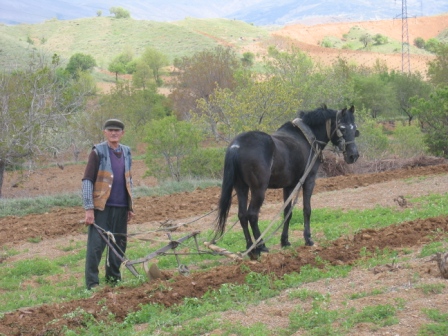
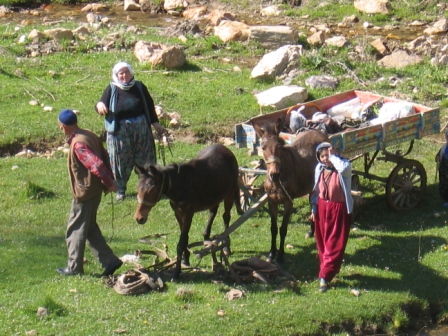
Approaching the Dinar area we couldn’t understand why there were so many ruined houses. Some villages were in two halves, old and new. People kept wobbling their hands in front of them and saying the word ‘deprem’ to us. Eventually the lira dropped. We realised deprem meant earthquake. Ten years ago a big one hit Dinar and killed four hundred people. As we rode by, the women working in the fields would look up nervously until they saw it was just Hannah thundering past to catch us up after another illegal crop raid. Trailers full of women, always pulled by tractors driven by men, would pile out of the villages every morning. At break times there’d be a big bright tablecloth laid out on the ground: bread, cheese, chillies, chatter and laughing. They’d always shout out and invite us to join them. At weekends whole families would be out working their land together: ploughing, harrowing, sowing, weeding.
In some areas, most of the work was done by horse. The horse would pull the family out to its plot then switch from cart to plough for some hard dragging. Donkeys were everywhere too, carrying people out to their fields, pulling carts, helping look after flocks of sheep. It was heartbreaking to see the kind of treatment that donkeys have to put up with (and do put up with without appearing to object): a huge great blob of a woman, somehow wedged into place on her tiny donkey’s wooden pack saddle, half of her enormous belly overflowing out the front and most of her arse doing the same at the other end; a shepherd just sitting in the saddle for a rest, his feet virtually touching the ground beside his tiny donkey’s hooves; being left tied up in the full heat of the sun, no one thinking to remove their heavy packsaddles; receiving a heavy stick blow on the right side of their head to move left, a crack on the left to move right.
The Turks ancestors
who galloped in over the steppe from Central Asia may well have been
skilled horsemen but, as far as we could see at least, any kind of
horsemanship has long since disappeared. People can’t comprehend why
we refuse to just tie the horses up in the sun and come over to
drink çay. We try and explain that it’s hot, there’s no shade,
Hannah’s loaded up. But they never seem to understand. In Turkey,
the fuss is all about us not the horses. They always say the horses
are çok güzel (very beautiful) but don’t think for a minute about
what they might need. One man begged us to stay with him for the
night but we couldn’t see any possible place for them in his From the Dinar valley
we climbed again into yet another scene change: the Karakuş
Mountains. These came in an amazing variety of colours – red,
orange, yellow, silver, gold – but the one we really needed was
noticeably absent: green. Unable to bivi we were forced to press on
till we reached a village but when one finally arrived, just before
sundown, we found we’d been beaten to it by a couple of gypsy
families. Having other horses around is bad news at night so we
carried on still further, hoping our luck would I went off to check with the mayor but because I was from ‘abroad’ I got forced into the house of the only man in the village who’d ever been there. Lots of villages have a man who’s ‘arbeiten in Deutschland’ and he’s always dragged out to meet and talk to us, despite the fact we don’t speak German. This one had spent twenty four years working in the Opel factory in Stuttgart. Over seven cups of tea, he told me all about it at great length in German and Turkish. I lost count of the number of his sons that came round to shake hands. When I finally escaped it was pitch dark. With bursting bladder I staggered back to the tent, determined to share with Lisa all the knowledge/pain of my new specialist subject, German Car Manufacturing (1965 to 1989). But another figure was converging on the tent at the same time. In his hand was a tray and on the tray was…oh no, it can’t be…it is…three glasses, a bowl of sugar and a giant flask of tea.
Next day, to avoid
the inevitable hassle of a village green lunch stop, we’d taken a
gamble and carried on through the desert of wheat. Luckily we found
a narrow strip of grass on the edge of an orchard, just big enough
for an hour or two’s grazing and, best of all, not a soul in sight.
Captain Kirk thought he had Klingon problems on the Starship
Enterprise; Scottie should have beamed him down to Turkey for some
training. We’d finished unloading, put the horses on their ropes,
given them water and the minute we
This got us thinking. Our Klingon difficulties were surely all down to image. We’re doing basically the same thing as the gypsies: find some grass, move on, find some more grass, move on again. Why couldn’t we make our eyes flash? Why didn’t people think we were carrying meat cleavers? Instead we go into a village and come out the other end with thirty kids in tow screaming “Turist! Turist! Turist! Mynameis? Mynameis?” Or, in the case of one confused little high-pitched girl at about 6pm: “Good morning teacher! Good morning teacher!”
One night, the only
decent grass we could find was just out of sight of a village but
just in sight from the main tractor route back in from the fields.
We were spotted within minutes, word got around and the visitations
began, first a trickle, then the flood. Questions, handshakes,
questions, handshakes, non-stop all evening. When the last people
left, long after dark, we finally dropped to the horizontal and
crashed out asleep. An hour later the tent was being shaken
vigorously, accompanied by “Hello? Hello? Hello?” On the verge of a
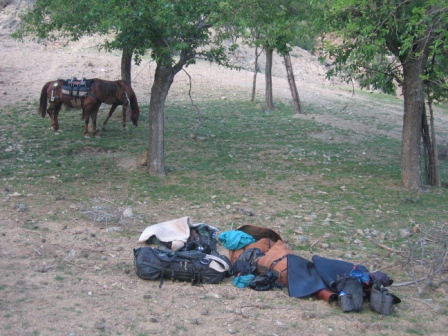
sense of humour failure, I unzipped the door a few inches. It Luckily in this period we hit on a superb long run of bivi spots. Somehow or other, even on days when things were looking grim, we managed to keep finding good grass. Life became beautifully, rhythmically simple. The horses were strong and flying along. All you need is ot (grass) and su (water). Night after night we found them. Sunset, sleep, sunrise. Mornings are best, just after setting off, rested, refreshed, no need to even think about grass for a while, just enjoying the new day and the movement.
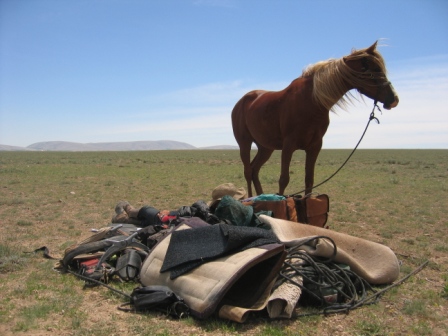
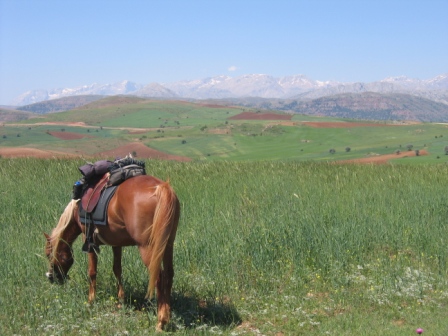
Crossing a high col in the Sultan Dağları (mountains) one day we found a stunning alpine meadow with a sparkling spring. It would have been a criminal offence to ride past such good grass so we gave ourselves an afternoon off. Audin, Hannah and Sealeah thought it was an excellent decision and tucked in. We washed clothes, tack and bodies in the warm sunshine and feasted our eyes on the beautiful mountain panorama.
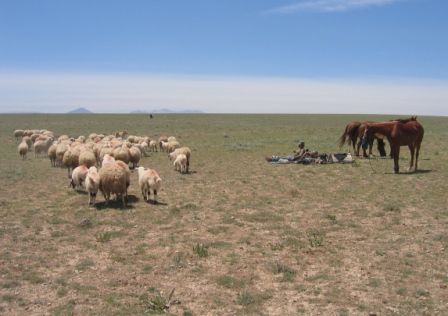
After the Sultans came our second set of Boz’s - we must have come a long way in Turkey, they’re starting to run out of new names for mountain ranges – but after four or five days across these dropped onto the vast plain northeast of Konya. It was easy to see why the Seljuk Turks, invading horsemen from Central Asia, had liked this area enough to make Konya their capital. A thousand years ago this grassland steppe must have seemed infinite. Now much of it has been ploughed up for wheat but there’s plenty still left.
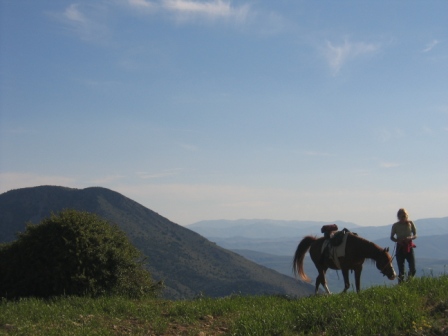
When the going gets good, the good get going; the horses knew it was time for a canter. We read their minds, or they read ours. Surely there’s no better way to experience this landscape than to be a horse below the waist? After so many hours, days, weeks, months in the saddle we have become centaurs, bowling along, eating up the ground. (It hits you too after a couple of days off: swing back into the saddle and it just feels right, as though you’ve got your proper legs back again.
It must be annoying for the lower half when the upper half makes a bad decision. One blistering thirsty afternoon we passed a distinctly derelict-looking well about ten yards or so off to our left. There was no bucket or rope, the ground around was dusty, the well must have dried up I thought. But Sealeah pulled hard towards it. “Su yok! (there’s no water)” I told her (she’s pretty good at Turkish now) and turned her away. But the lower half insisted and the upper half gave in. The lower half was right, she’d smelt water and it was there. Two heads are better than one, even if one’s a human’s.
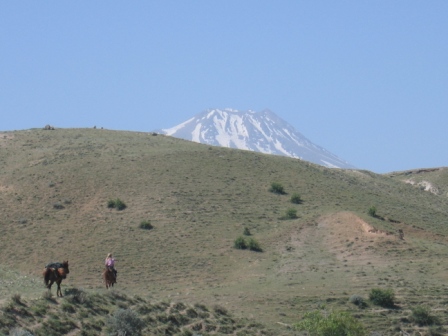
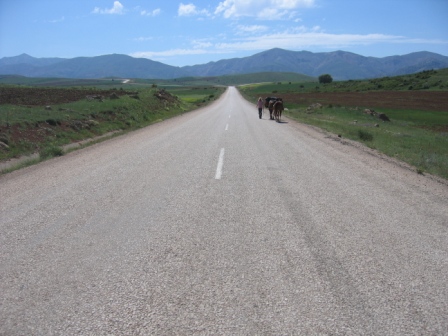
As we cantered across these plains there was a constant and growing presence on the eastern horizon, the Hasan volcano standing at 3268m. We were heading towards it and it was so big and so far away it stayed due east no matter how much we veered off course. For four or five days the compass could stay in my pocket, we just rode towards the volcano. This was most relaxing for the Chief Navigator, who’s had something of a struggle in Turkey: a map drawn at 1:430,000 that doesn’t bother with topographical details apart from the occasional wild stab at where a major river might be; a man running out of his house in panic to tell us that we were going the wrong way for Istanbul; people always assuming we must want to go to the nearest big town or city (the exact opposite is true); people always directing us proudly towards the road that’s ‘asfalt, asfalt’ (when we’re desperately trying to discover whether there’s a path or a dirt road.) On the plus side, getting lost is nowhere near as bad as its cracked up to be. As long as we can keep moving roughly in the right direction, its better by far to be lost on a hillside track than know exactly where you are on an asphalt valley road. What’s a few extra days anyway, between friends?
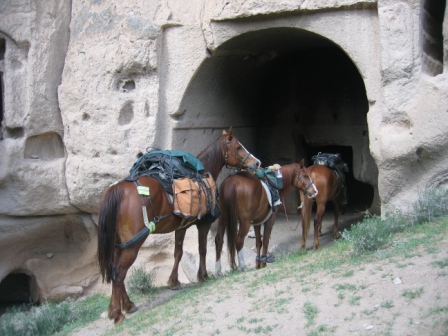
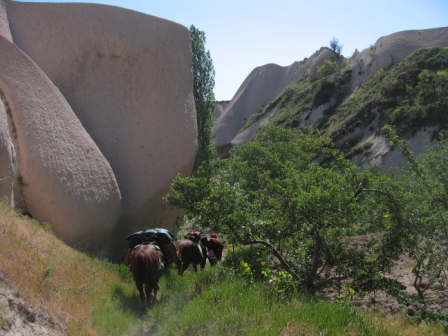
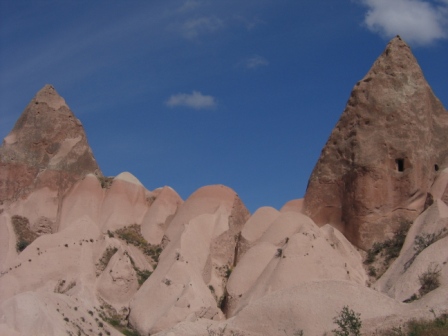
Eventually the big volcano swung round to our south and we found ourselves riding through its spew-zone (apologies for using technical volcanologistical term), picking our way through the pumice. A northwards deviation for a day took us to the spectacular Ilhara Gorge, riding along the rim for a few hours then dropping down into the canyon and following it to its end at Selime. There was almost too much scenery to take in all at once. Eleventh century Christians had carved churches into the soft rock of the canyon walls – we took the horses into a few and they liked them, thought they were cool. At Selime we weaved through a hillside of fairy chimneys, conical towers created by centuries of erosion. We had reached the magical world of Cappadocia.
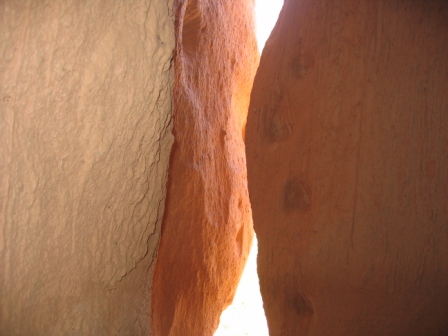
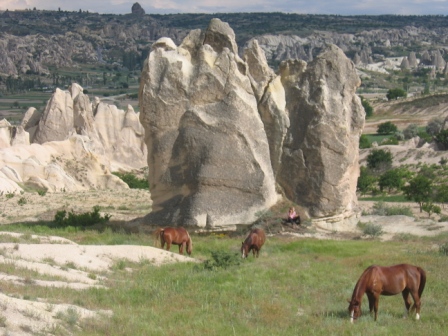
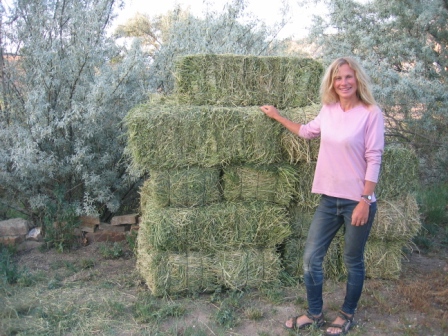
A couple of days later we found a good base for a week’s rest in the tourist capital, Göreme. Within a few hours we had acquired a stack of twenty bales of top quality lucerne hay and a sack of barley. We were on a campsite with a swimming pool but no other campers. We could take it in turns to stroll into town and be blissfully anonymous for a change. We could take the horses out to good grazing among the fantabulous fairy chimneys and icecream-coloured rocks. We rode up Rose Valley for a day, through carved tunnels in the rock, past thousand year old churches, winding up down and around all the chaos of towers and buttresses.
The horses learned all about hot air ballooning (not on the curriculum but there’s nothing wrong with further education). Six chestnut ears would be fixed on the take off field every morning and then follow the dozen or so balloons as they blasted away just over their heads. After nearly a month from Pamukkale with only one full rest day, the horses had arrived fit, strong and fat. We’d hit a sustainable rhythm; happy as the grass was green. After a week at Göreme they left even fatter.
"Until man duplicates a blade of grass, nature can laugh at his
so-called scientific knowledge." From Cappadocia we had to make a sharp right turn. A Mecca-facing man on his mat was praying southwards; it was time for us to head that way too. The next few days were big country days, of wide open spaces and breathtaking views, the towering Erciyes volcano (3917m) to our left and the striking snow peaks of the Aladağ mountains straight ahead.
Without a decent map we couldn’t risk trying to cross the highest, alpine part of the Aladağ range – it’s unlikely that a horseable route exists at all – so we settled for a northerly line where the tops were almost free of snow. In Dündalı, our last village on the western side of the range, we discovered an extremely effective new means of getting rid of a chain of screaming mini-klingons: grass on them to a grown-up. They’d started to throw stones at Hannah so we just mentioned this in passing to a man standing outside his house. In seconds he’d silenced them all and sent them packing, back to whatever it was they’d been doing before we – the travelling entertainment – had arrived. Result. To be fair, we have only experienced stone-throwing kids a couple of times in Turkey. This is remarkable considering the example set to them by their parents: stick and stone throwing appears to be the preferred method of communication with animals. We’ve watched shepherds running around frantically, throwing stones and shouting, while their sheepdogs doze under the shade of a nearby tree; helping to move the sheep is just not included in these dogs’ job descriptions. Lisa was amused when one shepherd violently hurled his stick into the middle of his flock - complete with blood-curdling cry of “haaiiyy!” – and not a single sheep batted an eyelid. I wonder if you can get ‘One Man and his Dog’ on satellite?
It took three attempts at three different valleys to find a passable route over the mountains. Everyone had said yes, there was a path but it was “eski” (old). ‘Dead’ would have been closer to the truth. Knackered from three false starts and scrambling up the steep slopes on rough terrain, we finally reached the col just as the sun dipped below the ridge behind us. We might have had an epic on our hands but luckily the terrain was gentler on this side and, just a stone’s throw from the col, we found some long grass and a spot flat enough for the tent. The horses tucked in and we fell asleep before we’d even hit the horizontal.
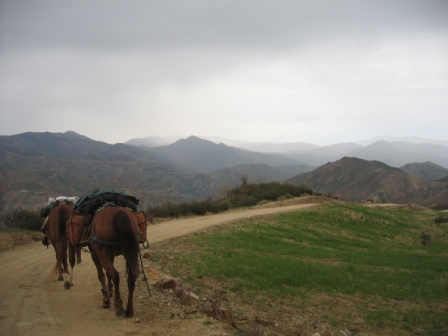
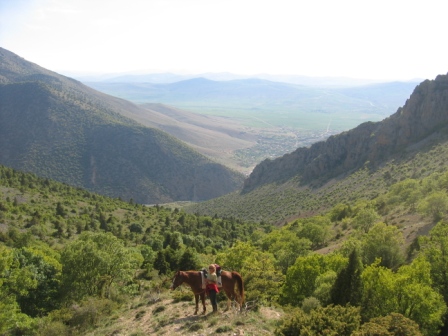
Our luck with the grass held out for a few days as we followed lush valleys and crossed rolling grasslands again. It was only after the village of Mansurlu that everything changed. Where were the warning signs? “Fill up here! Last grass for 100km!” In blind ignorance we just left a lush broad valley, passed over a small col and found ourselves descending into another world, an enormous deep gorge with barely a blade of grass in sight. We were in the Toros (or Taurus) Mountains and this section marked the start of a sharp drop in altitude from the high central plain down to Mediterranean level. These mountains had looked bad on the map - the name of the range was shown in suspiciously big bold lettering - but the territory was even worse: steep, forested valley sides plunging over huge cliffs into seemingly bottomless gorges. In this terrain we were forced to follow tracks (none of which were shown on our map of course), use the compass to make a wild guess at junctions and hope that the mountains would eventually spit us out intact somewhere at the other end.
Amazingly, people were still trying to make a living here, despite the steepness of the valley sides. Their homes resembled tree houses, all poles and decks, steps and ladders. Private plots were fiercely protected by all manner of stakes and netting. But even inside these enclosures there was hardly enough forage to keep a goat amused. Outside, things were desperate. At the end of our first day in gorgeland, a hungry night for the horses was looking inevitable but we were rescued by the kindness of a man who gave us a bag of chopped oat straw, despite it clearly being a precious resource in these parts.
The second day was just tortuous. We started only ten kilometres
north of a key bridge on the big Seyhan Nehri River but it took us
forty kilometers to get there, forced to move for hours in the wrong
direction just to find a way across a deep side-gorge. From the
bridge we spotted a half-decent patch of green on the riverbank,
just enough for a one night stop. We celebrated with a huge
driftwood campfire. By the end of a third hard day we were relieved
to find that the valleys were starting to open out. A thank-God
grazing meadow below the track was so welcoming we stopped for a
rest We finally dropped
out of the Taurus Mountains and into a haze of sweaty mugginess on
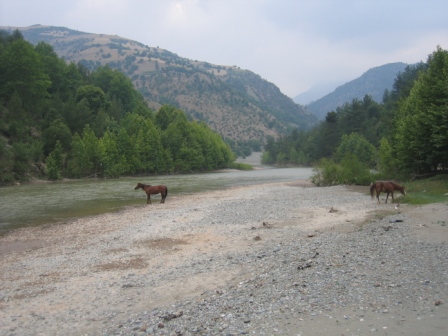
the coastal plain. We stopped at every water source to drink, slosh
the horses, soak T-shirts and submerge heads. The insects now came
out with a vengeance; tails swished and hooves stretched and kicked
to reach the places tails couldn’t. Hannah and Sealeah will swish
nose to tail with Audin but not with each other; the result is often
an Audin-sandwich made from two thick slices of mare. For us,
walking along behind Hannah is hazardous in these conditions; she’s
been warned
We rode across stubble and past orchards dripping in oranges, lemons, figs. I even found ripe blackberries. It was only mid-June but it felt like early autumn, harvest-time. From here we could have continued more or less directly to the sea but on the map we spotted a national park, only slightly off route. Its name was ‘Karatepe’ (Black Mountain), how could we resist? We’d crossed seventeen mountain ranges in Turkey, just one more wouldn’t hurt. It turned out to be well worth it: pretty hills, a bivi by a tranquil lake and a surprise gift, a three thousand year old Hittite city fortress with intricate carvings and hieroglyph inscriptions (complete with carved subtitles in Phoenician).
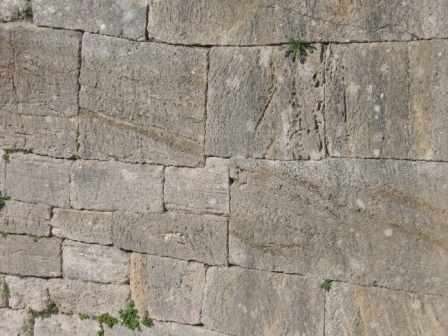
Descending from Karatepe we rode beneath imposing crusader castles at Bodrumkale and Toprakkale to finally reach the Mediterranean coast just as it starts to turn south on its way down to Egypt. How many armies have marched along this narrow coastal strip over the centuries? Lots probably. Alexander the Great (or ‘Great Alexander’ as our friend Stavros in Greece called him) has been following us around ever since Thrace. It was here at Issus, in 333BC, that he had one of his famous scraps with King Darius and the Persians. All we could manage was a swim but that felt pretty good to us.
I thought that love would last for ever: I was wrong
W.H.Auden, Funeral Blues
Lisa
writes:-
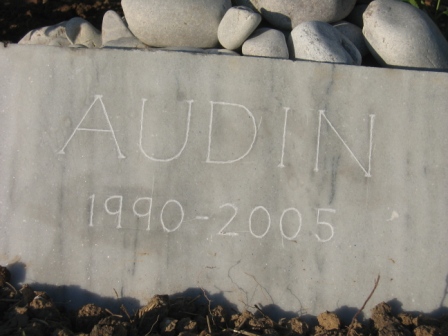
Two days later we had stopped for lunch on the edge of a lemon grove. There was water and shade and plenty of grass and the horses had some rolled barley. I felt well enough to eat a tomato and some biscuits, though Audin helped himself to most of these. A nice old Kurdish man came over for a chat and to explain to us the Kurdish situation (of which we had been informed many times) in Turkey. Suddenly everything changed. Harry got very feverish and vomited violently. At the same moment Audin started to look uncomfortably at his flanks and rolled – we had to move on to somewhere we could deal with these problems. I gave Auds a mild painkiller, Harry deliriously helped me load Hannah and scrambled onto Sealy’s back. I led Audin along the road to be told there was a campsite a few kilometres further on. When I got there it was obviously defunct but – our only luck on this terrible day – the sympathetic owner, Fuat, was there. I explained our situation and he said we could stay. There was grass and shade for the mares so I could concentrate on Audin. Luckily we carry a stomach tube and all the drugs needed for ‘medical’ cases of colic so I could get on with assessing the problem, stomach tubing him etc. There was no indication from rectal examination or clinical parameters that he would need surgery but the picture can change very quickly with colic so I asked Fuat if he could tell me where the nearest horse hospital was. (Colic simply means abdominal pain. It can be mild and transient or caused by a simple blockage or gas build-up which can be easily treated medically but the horse’s gut is long and complicated and subject to many types of entrapment displacement and twists which need surgical correction, although this doesn’t even then guarantee a successful outcome. Only very well equipped clinics are able to offer colic surgery, even in Britain there are only a limited number of such clinics. The surgery itself is difficult and has high rates of mortality and complications compared to other types of surgery even in state of the art clinics.) Fuat couldn’t understand why I needed to take Audin to a clinic as ‘he wasn’t too bad’ but if there’s one thing I’ve learned as a vet, with colic it is better to be one step ahead JUST IN CASE as in surgical cases time is of the essence. Anyway, after protracted and fruitless attempts to contact a Turkish friend who had horses and would know whether there was a suitable clinic at this end of Turkey (we don’t carry a mobile so had to use Fuat’s phone), Fuat’s cousin, also a vet, arrived. Again it took a bit of time to overcome language and cultural obstacles but in the end he rang the veterinary faculty at nearby Hatay for me. By now it was evening and Harry, extremely ill, had passed out. Unfortunately the clinic in Hatay did not have the necessary expertise or facilities but found me the number of a clinic in Adana five hours away. In the meantime Fuat arranged for a lorry to be on standby to transport Audin. After a long wait the other vet contacted the Adana clinic but he was told they didn’t have the anaesthetic facilities needed for colic surgery. I had put Audin on a drip to maintain good circulatory and hydration status while these painfully slow discussions were taking place. I had heard there was a good clinic in Izmir, but did not know if they did colic surgery (admittedly this was at the other end of Turkey and probably not realistically an option but I was clutching at straws). The vet said he’d drive to his own clinic to get the Izmir number and also I asked for more fluids so I could keep Audin on a drip while he was transported. As he drove off into the dark a thunderstorm with torrential rain blew up. I put Auds under a very leaky palm-thatch shelter, put my sleeping bag on his back with a waterproof on top. The vet said he’d be about half an hour. So I sat there, with Audin’s head in my arms waiting, monitoring him, crying, desperate. The minutes crawled by like hours and as I regularly checked his pulse rate and gut sounds I saw that a lot more than half an hour had gone by. By now everyone else had gone to bed. At 1am Fuat’s son, Deniz, came to tell me that the vet had written his car off in a flood, walked a long way home in the rain and would not be back until morning. He also said that it was a twenty hour drive to Izmir. These words were the final hammer blows, I had run out of options. The next few hours were misery, the worst of my life. Audin wasn’t getting worse but he wasn’t getting better either. The only decision I had left to make was to put him to sleep to avoid further suffering if it became certain that there was no hope of recovery. I gave him a very strong painkiller, I knew that this might simply mask further deterioration but had no other options left. As dawn approached he had longer and longer comfortable periods and by morning was slowly improving in demeanour. His colour was good and gut sounds getting better, in my heart I knew this could be solely due to the powerful drug that I had given him and not true grounds for hope, but my mind could not bear to think of this. Harry emerged, still very ill but no longer so feverish and delirious, and helped me take a fluid sample (which was normal in appearance) from Audin’s abdomen, repeat rectal examination and stomach tubing. There was still grave cause for concern but over the next hours Audin got brighter, started passing dung and looking for grass as I led him gently round the campsite. I then put him back into the paddock that we had made, for him to have a rest. Soon he became very uncomfortable. I checked his pulse – it had shot up, he tried to roll, he was in an awkward place against a fence so I ran to get Harry to help me. We were back in seconds, Audin was back on his feet but had gone into crisis, we ran to him and tried to get control but he died within moments. I am writing this five days later sitting by his grave, which thanks to Fuat and Miryam is beautiful. They have planted trees, Harry has carved a marble plaque and it is situated on a piece of private ground above the sea. My eyes are aching from crying but I still can’t stop. Poor Hannah is constantly calling for her father. Writing this has been horrible for me but I have done it so that our friends and family know what happened to Audin; its not something I want to relive again. I keep going over and over the last days of his life but I can’t pinpoint anything that could have precipitated this disaster. He was a picture of health and vitality, he has always been regularly wormed – the last time ten days ago, he had his teeth rasped three months ago, we had had good grass every night since leaving the Taurus Mountains (In fact I have to say that although, of necessity, the horses’ diet has sometimes been irregular on this trip, none of the horses have had the slightest digestive problem in fourteen months) A bit of me would have done a PM to confirm the cause but cutting into him was more than İ could do. In my mind I know horses are subject to such abdominal disasters, I know that good friends have lost well-loved horses in the same way at home and that if the same thing had happened at home I would have been at work and he would have suffered for hours before I would even know there was a problem. But it still seems a bitterly cruel fate to befall such a gentle, loving, generous little horse and I am utterly heartbroken. My mind is full of memories of all the good times we had over the fourteen years we were together; he was a real fun horse and a complete clown. I bought him as a yearling from Emrys Jones and I remember saying a while later to Emrys that even if he turned out to be a useless riding horse he was worth every penny of his purchase price just for the entertainment value of his antics. In actual fact he turned out to be a dream to ride. He was very agile with powerful hocks which was a big benefit riding on the rough Black Mountain at home, not to say crossing the Alps. He was also very enthusiastic and during this journey often started the day powering along at his ‘bionic’ walk which no-one else could keep up with. He had lovely smooth paces, so much so that I rode the last thousand miles in Turkey without stirrups – having lost one in a forest – and barely missed them, although he often threw in joyful bucks at canter and many times I’ve nearly fallen off laughing. He was, though, a bit of a drama queen and if presented with a situation which he felt to be beyond him would have no qualms about dropping to the ground in order to express his view on the matter. I remember him doing this one time as a youngster as an objection to walking through a flooded path on the mountain (we are talking inches here). When I insisted, he went to Plan B, which was to drink it. In the end he took courage in both hands and tiptoed through; how very many raging rivers he has crossed since then. Even so, after all he’s seen and done, there are certain things (and he’s very consistent about these) which he cannot countenance, e.g. railings, flowerpots, piles of gravel, irrigation pumping stations, though the famous ‘new rug’ incident is probably the ultimate in his repertoire of oscar-worthy performances. Having said that, exhibitionist though he was, he was extremely intelligent and cooperative. If he knew what you were trying to do, e.g. open a gate or untie Hannah’s rope from on his back or put his hobbles on, he would always do his best to make your job easier. He was an absolute joy to travel with, he never ever caused any trouble and would always call me over with a soft whinny to deal with problems such as tangled tether ropes or knocked over water buckets. Above all he was extraordinarily gentle and loving. He liked to lick and kiss peoples’ faces and often embarrassed me by stopping abruptly to greet a passer-by who might be on the pavement as we rode past. His sweet nature was such that, though Harry and I might have occasional ‘domestics’ and the mares have the odd tiff, he was never anything but good tempered, this to the extent that more than once Harry has complained “that horse makes you feel guilty he’s so bloody perfect all the time.” The single exception to this in fourteen years was once when riding (Harry on Audin, me on my pony Skipper) on a mountain in Wales a man pulled over from the road – later we were told he was a known nutter – and started shouting abuse at us. Audin clearly felt we were under attack and decided after a few minutes to take matters into his own hands. He spun round from a standstill and gave the man both barrels, missing his head by inches. The colour drained from the man’s face and he beat a very rapid retreat: “that horse is dangerous”. In fact “that horse” was the gentlest soul imaginable, he was just defending us as best he could. Audin and I have always had a very close relationship. Like many arabs he was a very people-oriented and communicative horse. However, the miles, months and challenges we have shared during this journey intensified our bond and mutual understanding to a degree I would not have believed possible. His death marks the end of the happiest fourteen months of my life. It is some consolation that he, if his boundless enthusiasm and constant good humour are anything to go by, thoroughly enjoyed this journey too. I could tell a hundred tales of his intelligence and loyalty but suffice it to say he was a true gentleman and one of the best friends I ever expect to have. Having been my constant close companion for the last fourteen months and five thousand miles, losing him has felt like undergoing an unanaesthetised amputation; part of me has gone.
Losing Audin turned
our world upside down. What to do now? We’d talked so many times
about the risks but to talk is one thing, to deal with the reality
another; now we just couldn’t think straight. Lisa couldn’t stop
going over and over the events, trying, but
Everyone said we
should carry on but we were too close to the pain and too knocked
sideways to know what was best. When travelling, the relationship
with the horse is so intensified by the experience of living and
doing everything together day after day; when such a strong bond is
suddenly broken, it hurts. If only we could teleport ourselves
instantly back home, turn the horses out in twenty acres of long
sweet grass, watch them drinking from the stream…But this part of
Turkey has no import agreement with the EU so we’d first have to
truck the horses back to western Turkey, then sit out three months
of quarantine – not an attractive prospect. Without reaching any
kind of decision, we found ourselves going through the motions for
carrying on as planned and The mares were clearly distressed that Audin was no longer with them and their anguish added to ours. As Hannah’s father and Sealeah’s only four-legged friend he’d been the linchpin, the peacemaker, the man in the middle. In the first few days they called for him over and over again but there was nothing we could do to bring him back. Subconsciously we found that we’d decided to carry on with Hannah and Sealeah into Syria, see how things went and see how we felt. Fuat’s wife, Miriam loaded us up with vast quantities of bread, apples, cheese and olives and we set off down the coast. We knew Audin’s grave would be safe there but leaving him was still a huge wrench; we walked in silence and sombre mood. It was the mares’ enthusiasm for moving again that eventually lifted us from the gloom. Despite the heat they powered along as if to say “come on, let’s get on with it!” We hugged the shoreline and passed south of Antakya (formerly known as Antioch and once an important Syrian city – in fact, this whole Hatay region is still regarded by Syria as rightfully theirs and shown as such on Syrian maps.) After Arsuz, the mountains forgot to look where they were going and fell straight into the sea. The road became a rough track blasted into the cliffs and it took us along a beautiful stretch of rugged, empty coastline. Streams spilling down from the crags above provided much needed water and swims in the sea cooled us all down.
After Samandag, a steep zigzag climb in sweltering heat led into the Yayladag mountains. It was bumpy riding because the mares were so irritated by the flies they couldn’t stop kicking up at their bellies. In the humid conditions this left them dripping in sweat and we had to water them as often as possible. Passing a house in late afternoon, I asked if they had water: “su var?” A short spherical woman came over shouting “var! var! (there is!)” She weebled back to her house and emerged, still gibbering loudly, with a jug and poured us a small glass. “Err, thank you but…the horses…is there water for the horses?” The woman was typical of so many Turkish people we’d met in the previous four months: welcoming, generous, excited to have us there but no concept that the horses might also want to drink, eat or rest in some shade. The woman led us a hundred yards up the road to a trough with “su guzel (beautiful water)” and said we could camp on the land beside it. Still wanting to help us she brought over a pot of chai and a pile of freshly made flat breads wrapped up in a cloth. How could we fault these people?
In the early hours we woke shivering. The heat of the day had made us forget that at 1000m it could still get chilly at night. Not that we could have done anything about it. We’d had to ditch as much gear as possible now that Hannah was carrying Lisa instead of the pack saddle and panniers. No more flysheet for the tent, no more sleeping bags, no stove and pans, no warm clothes. It was only a couple of hours from there to the Syrian border and the walking soon warmed us up. We stopped only once – Sealeah insisted, having spotted some extra green grass on the verge outside a house. A girl came from the house and gave us each a handful of perfectly ripe, sweet plums. Was this a final reminder? Don’t forget us Turks and our kindness! |


 road, we reached an empty
beach. The waves lapping the shore were only just bigger than
ripples so we rode straight in, tired tendons enjoying a saltwater
soak.
road, we reached an empty
beach. The waves lapping the shore were only just bigger than
ripples so we rode straight in, tired tendons enjoying a saltwater
soak.






 thoroughly ruined.
After a
thoroughly ruined.
After a  goatherds drive their
livestock to every accessible patch of land. Anything that looked
promisingly green from a distance usually turned out to be enclosed,
protected by a barrier of cut thorn branches. If we failed to find
good enough grass for a night we’d have to go into a village, but
often the only forage available there would be straw (not enough
food value for the amount of work we were doing). Luckily, somehow
or other, we did nearly always manage to find enough grass before
‘all the ways grew dark’. Hannah can carry enough grain and oil for
three or four nights and this gave us enough time to cross each
range and the freedom to stop anywhere, grass and water supply
permitting.
goatherds drive their
livestock to every accessible patch of land. Anything that looked
promisingly green from a distance usually turned out to be enclosed,
protected by a barrier of cut thorn branches. If we failed to find
good enough grass for a night we’d have to go into a village, but
often the only forage available there would be straw (not enough
food value for the amount of work we were doing). Luckily, somehow
or other, we did nearly always manage to find enough grass before
‘all the ways grew dark’. Hannah can carry enough grain and oil for
three or four nights and this gave us enough time to cross each
range and the freedom to stop anywhere, grass and water supply
permitting.






 supposed to. Now in Wales
this sort of behaviour just wouldn’t be acceptable. You’d never be
allowed to keep going at this kind of altitude without being forced
back down again and straight into the nearest pub for a celebratory
pint. But Turkey’s big and it has a very big high bit in the middle:
the Central Anatolian plateau. On the first morning in May, we woke
to find ice on the tent and the kind of nip in the air that we’d
thought had been left well behind.
supposed to. Now in Wales
this sort of behaviour just wouldn’t be acceptable. You’d never be
allowed to keep going at this kind of altitude without being forced
back down again and straight into the nearest pub for a celebratory
pint. But Turkey’s big and it has a very big high bit in the middle:
the Central Anatolian plateau. On the first morning in May, we woke
to find ice on the tent and the kind of nip in the air that we’d
thought had been left well behind.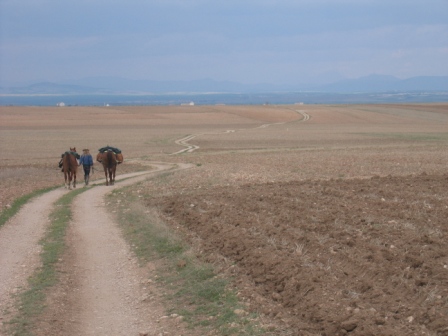 that we must have moved some way
across the planet, the birds suddenly all seemed to have changed,
now it was rollers and hoopoes keeping us company as we rode.
that we must have moved some way
across the planet, the birds suddenly all seemed to have changed,
now it was rollers and hoopoes keeping us company as we rode.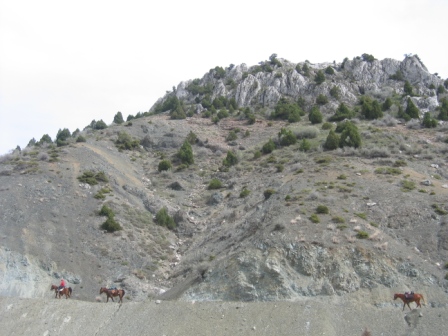 country could possibly need to
feed itself. But then we’d reach a village and immediately ask for ekmek (bread) and arpa (barley).
country could possibly need to
feed itself. But then we’d reach a village and immediately ask for ekmek (bread) and arpa (barley).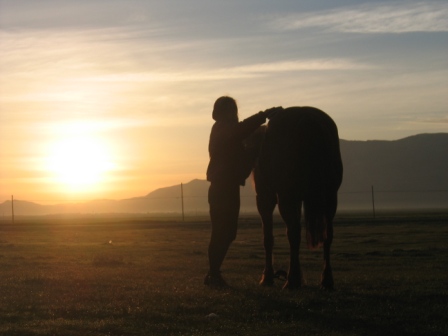


 but go and
tell the mayor you’re here. I went to find him but on the way a man
told me the mayor was out but not to worry, he’d tell him for us.
but go and
tell the mayor you’re here. I went to find him but on the way a man
told me the mayor was out but not to worry, he’d tell him for us. next day. Three
encounters, three meals, faultless kindness. By now I’m probably
starting to sound like the fat boy, away from home for the first
time, writing home to his mother and only talking about the food.
I’d better move on.
next day. Three
encounters, three meals, faultless kindness. By now I’m probably
starting to sound like the fat boy, away from home for the first
time, writing home to his mother and only talking about the food.
I’d better move on.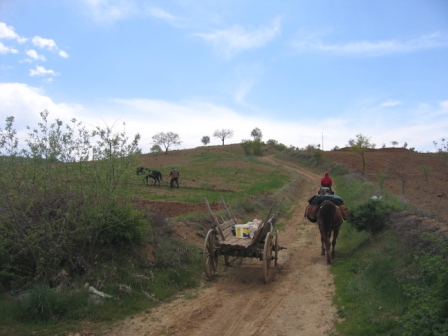


 little
yard. His suggestion? Tie them up short, one to each steel blade of
the plough…that was fixed to the back of his tractor…that was parked
on the asphalt road. We moved on.
little
yard. His suggestion? Tie them up short, one to each steel blade of
the plough…that was fixed to the back of his tractor…that was parked
on the asphalt road. We moved on. change. It did, the
next village common was empty, all the grazing animals had been shut
up in bed.
change. It did, the
next village common was empty, all the grazing animals had been shut
up in bed.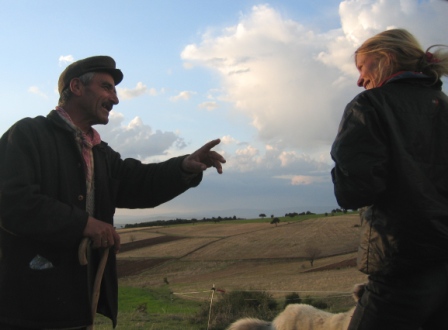
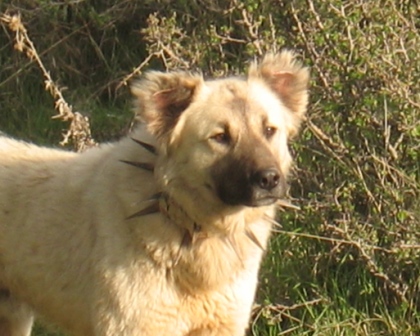

 finally sat down a Klingon
appeared from nowhere, parked himself on our starboard bow and
settled down for a game of Twenty (thousand) Questions and a good
long stare. Unable to bear the thought that he might be the only one
from his village to have seen the aliens, he spent a good half hour
shouting into his mobile telling all his mates to come over, which
they did. When our gypsy friends (we’d passed each other a few times
on the road and exchanged waves) rolled past in the distance the
Klingons all leapt to their feet and pointed and said they were kötü
(bad) people and would slit our throats in the night.
finally sat down a Klingon
appeared from nowhere, parked himself on our starboard bow and
settled down for a game of Twenty (thousand) Questions and a good
long stare. Unable to bear the thought that he might be the only one
from his village to have seen the aliens, he spent a good half hour
shouting into his mobile telling all his mates to come over, which
they did. When our gypsy friends (we’d passed each other a few times
on the road and exchanged waves) rolled past in the distance the
Klingons all leapt to their feet and pointed and said they were kötü
(bad) people and would slit our throats in the night.

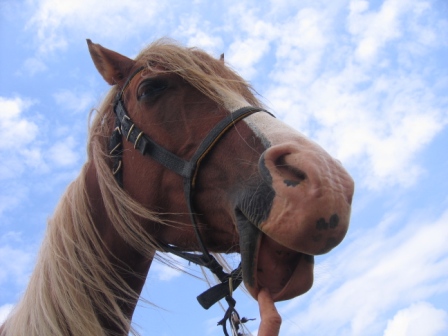
 was
night, we were sleeping, what did they want? Three right hands were
lined up for shaking “Hoş geldiniz! (Welcome!) Hoş geldiniz! Hoş
geldiniz!” Thank you, “hoş bulduk” (nice to be here), zip tent back
up, crash back to sleep. This Turkish hospitality lark is a full
package deal, you have to take the rough with the smooth.
was
night, we were sleeping, what did they want? Three right hands were
lined up for shaking “Hoş geldiniz! (Welcome!) Hoş geldiniz! Hoş
geldiniz!” Thank you, “hoş bulduk” (nice to be here), zip tent back
up, crash back to sleep. This Turkish hospitality lark is a full
package deal, you have to take the rough with the smooth.


















 day. Our own food supplies had run out by this stage but the
fruits on the mulberry and cherry trees were ripe and they kept us
going.
day. Our own food supplies had run out by this stage but the
fruits on the mulberry and cherry trees were ripe and they kept us
going. many times that she could have someone’s eye out with
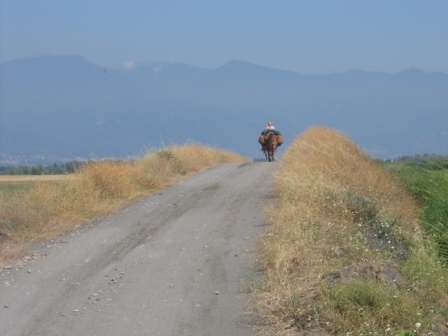
that thing. As he stands chilling out after a day’s activities, Audin gets a double swishing and seems quite happy about it.
many times that she could have someone’s eye out with
that thing. As he stands chilling out after a day’s activities, Audin gets a double swishing and seems quite happy about it.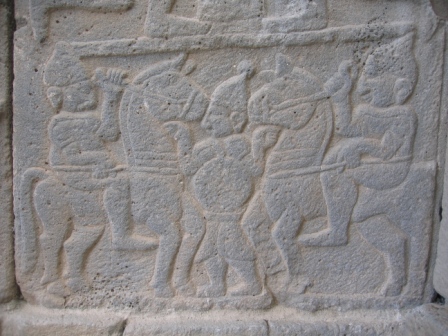




 failing, to think of
anything else she could have done. Phone calls and emails to family
and friends were painful but the support from others gave us a
boost.
failing, to think of
anything else she could have done. Phone calls and emails to family
and friends were painful but the support from others gave us a
boost. getting into Syria: I collected visas
from Ankara; Lisa obtained a horse health paper (of sorts) from Antakya.
getting into Syria: I collected visas
from Ankara; Lisa obtained a horse health paper (of sorts) from Antakya.